Field-proven building blocks. Patent-pending system. An AI campus that generates its own power produces downwind engine generator exhaust (NOₓ, PM-2.5, formaldehyde) emissions, waste heat, CO₂, cooling-water demand, and noise. E2F turns the first four into fertilizer, biochar, greenhouse crops, and cooling — and quiets the fifth.

Circular Farming Enables
Good Neighbor Data Centers

E2F eliminates the emissions problem and the water-consumption problem at the same time: the exhaust becomes fertilizer, the waste heat becomes server cooling that draws no evaporative water, and the farm waste next door becomes biochar — with everything that leaves the stack measured and published.

E2F (Emissions-to-Fertilizer) is a downstream, bolt-on system for AI campuses that generate power on site with gas turbines or gas or diesel engines. It is built from field-proven industrial equipment, so it can be deployed with confidence today — and E2F’s patent-pending inventions are what make that equipment do what none of it could do alone: a conditioning chemistry that lets an ammonia scrubber capture engine nitrogen that would otherwise pass straight through, a heat-integration loop that runs the server chiller and the farm’s ammonia stripper from the same exhaust, and a closed reagent loop in which the farm supplies the scrubber and the scrubber supplies the farm. One installation, several results that do not exist in the parts.

Field-proven building blocks. Patent-pending system. Results none of them deliver alone.
Measure it. Publish it. Audit it.

E2F (Emissions-to-Fertilizer) — invented by Larry M. Shultz. U.S. patents pending.

>90%
Local air pollutants captured or converted
Zero
Evaporative cooling-water draw
15–30 MW
Net generation returned to compute
Quiet
Sound walls and isolation mounts for noise and vibration

Net generation is stated after E2F’s own fan, pump, and scrubbing loads (25–40 MW gross displaced electric-cooling load). Site figures are modeled per project from the machines, climate, and feedstock actually on hand.
What an AI Campus Produces —
and What Each Output Becomes

On-site generation is the fastest route to energized compute, and it moves the environmental questions from the grid to the fence line. Every output below is a physical quantity that can be measured at the stack, the meter, the truck scale, or the property line — and each one becomes something useful.

Output of on-site generationWhy it mattersWhat E2F does with itBuilt on
Nitrogen oxides (NOₓ)Ozone precursor; forms secondary PM2.5 downwind with ambient ammonia. Gas engines and turbines emit little soot but substantial NOₓ.Conditioned, then captured in an ammonia scrubber as ammonium-salt fertilizer.E2F’s patent-pending conditioning chemistry on scrubber hardware proven in refinery flue-gas service
Sulfur oxides (diesel, biogas)Sulfate PM2.5 precursor; acid gas.Captured as ammonium sulfate (21-0-0-24S).Utility-proven ammonium-sulfate scrubbing, fed by E2F’s reagent loop
PM2.5 soot, CO, formaldehydeDirect fence-line air-quality and health metrics; the items most often named in permit hearings.Soot scrubbed out and held as a segregated, tested stream; CO and formaldehyde oxidized.Wet-scrubbing and oxidation hardware standard on engines and turbines
Waste heat (exhaust; engine jacket water)Rejected to the air by conventional designs; on a reciprocating engine it is a second, lower-grade stream.Drives an ammonia–water absorption chiller for the servers, displacing 25–40 MW of electric chiller load (15–30 MW net).Industrial absorption chillers, driven by E2F’s patent-pending exhaust and jacket-water heat integration
Cooling-water demandEvaporative towers can consume millions of gallons a day, most of it lost to the atmosphere.Dry or hybrid heat rejection: evaporative cooling-water draw goes to zero; process water metered under the same ceiling.Dry coolers proven at power plants; made practical here because absorption cooling removes the compressor load
Carbon dioxideThe largest mass flow; dilute (3–10 vol%).A bounded share mineralized in the biochar composite; a controlled share of cleaned CO₂ feeds co-located greenhouses.Industrial carbonation and greenhouse enrichment, fed with cleaned, dilute stack gas by E2F’s patent-pending process
Farm waste nearby (manure, crop residue)A disposal cost for the farm; a feedstock for the AI campus.Digested, pressed, and pyrolyzed into mineral-biochar; nitrogen stripped from the liquid as ammonium sulfate and scrubber reagent.Dairy digesters, presses, strippers, and kilns, connected by E2F into its heat and reagent loops
Noise and vibrationThe complaint least discussed and most felt at the fence line: fan and engine noise, and the low-frequency rumble neighbors feel.Sound walls absorb the low-frequency rumble and suppress the noise; engine isolation mounts stop vibration at the source.Highway, rail, and industrial sound walls; OEM-standard engine isolation

Community-benefit agreements, tax revenue, and road funding are real and valuable. Mitigation is a different thing: it changes the physical quantities in this table. When it does, the benefit to the county is fertilizer delivered to farms down the road, soil carbon in county ground, a quiet fence line, and a public record of what left the stack. That is Circular Farming — and Circular Farming enables Good Neighbor Data Centers.

One Circular Farming Loop

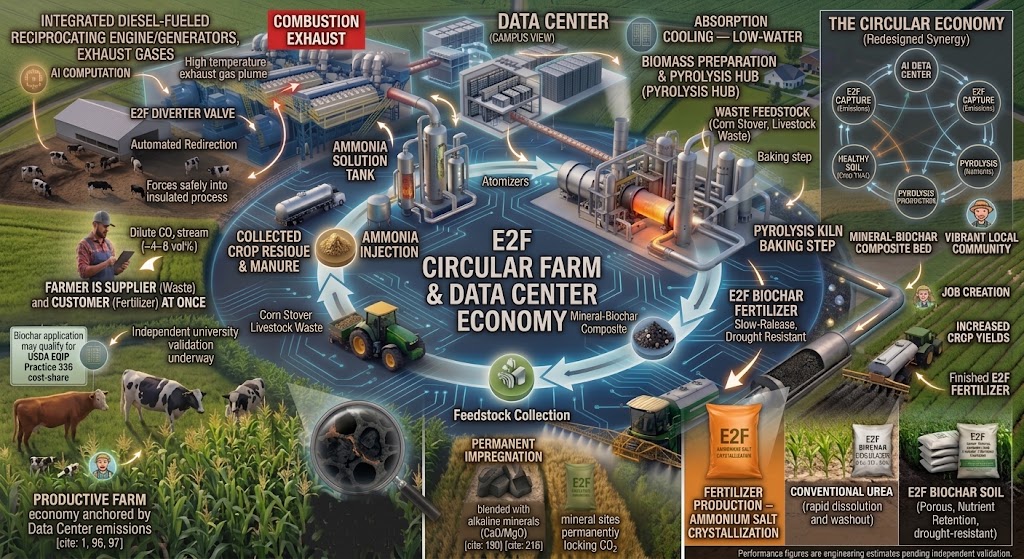
A gas- or diesel-fueled AI campus’s generator exhaust and waste heat become cleaned air, server cooling that draws no evaporative water, recovered ammonium fertilizer, mineral-biochar soil product, and greenhouse crops — anchoring the surrounding farm community, behind a sound wall that keeps the fence line quiet. One integrated loop; the greenhouse is an optional module for sites with a produce market.

E2F invented by Larry M. Shultz — data center pollution and water solution diagram: E2F converts AI data center power-generator exhaust (diesel and natural-gas engines and turbines) and waste heat into ammonium-salt fertilizer, mineral-biochar, and absorption cooling that draws no evaporative water for a circular farm and data center economy.

The full E2F loop, from generator exhaust to farm soil. Pinch to zoom on mobile. Emissions-to-Fertilizer (E2F) — invented by Larry M. Shultz.

Air. Water. Earth. Noise. Measure.

E2F attaches downstream of the exhaust and heat-recovery hardware on the gas turbines, gas engines, or diesel engines already in the power package. The hardware at each stage is field-proven; the chemistry and the loops that make it work together are E2F’s inventions.

Bolt on, downstream

Ducted after the exhaust stack with induced-draft fans and an integrated bypass. Back-pressure stays inside OEM limits; the generator never waits on E2F. On a certified Tier 4 diesel package the OEM aftertreatment stays in place and E2F installs behind it.

Condition, then recover the nitrogen

Roughly 90–95% of engine-out NOₓ from a diesel is nitric oxide, which barely dissolves in water. E2F’s patent-pending conditioning stage converts it to an absorbable form, and an ammonia scrubber — built on hardware proven in refinery flue-gas service, and made to work on engine exhaust by that conditioning step — captures the nitrogen and any sulfur as ammonium-salt fertilizers: ammonium sulfate, and ammonium nitrate solution where the permit and fire code allow. Better than 90 percent of the local air pollutants are captured or converted.

Polish the rest

Carbon monoxide and formaldehyde are oxidized. PM2.5 soot is scrubbed from the gas and held as a segregated stream, tested for metals and PAHs before any agricultural use. Ammonia slip is measured at the stack and reported.

The nitrogen balance

Half the nitrogen in a recovered ammonium salt comes from the exhaust and half from the ammonia reagent — the same ammonia an SCR would consume and destroy. E2F’s farm loop supplies that reagent from digestate ammonia recovered on the farm, closing the balance and turning a consumable into a product.

Why NOₓ matters even when there is little soot. Gas engines and turbines emit little primary soot but large amounts of NOₓ, a precursor that reacts with ambient ammonia over the following hours and downwind kilometers to form secondary fine-particle pollution. In ammonia-rich farm country that conversion is NOₓ-limited, so capturing the precursor at the stack is where it does the most good. E2F’s bypass design also guarantees that the AI campus never emits more than its permitted baseline, whatever the mitigation is doing.

Cool the servers with heat, not electricity

Generator exhaust — and, on gas and diesel reciprocating engines, ~85–95 °C jacket water — drives an ammonia–water absorption chiller, the workhorse of industrial refrigeration for a century. The chiller replaces compressor load the AI campus would otherwise feed from its own generators.

Reject the heat dry

Dry or hybrid fluid coolers replace evaporative cooling towers, so the evaporative cooling-water draw goes to zero. For a 150 MW-thermal AI campus that is ~0.68 billion gallons a year — about 1.9 million gallons a day, the indoor water of ~6,800 households.

Return the power to compute

Shifting cooling off electricity displaces ~25–40 MW of chiller load on a six-turbine AI campus; net of E2F’s own dry-cooler fans, pumps, and scrubbing auxiliaries, 15–30 MW returns to compute. E2F is sized to the hottest design day and reports net MW and gallons at peak, not annual averages.

Meter all of it

E2F’s own process water — scrubber makeup, product finishing, any hybrid-mode operation — is metered separately and reported under the same permit ceiling as the cooling system: a hard, metered annual and peak-day water budget.

Cooling-Water Consumption — 150 MW-Thermal AI Campus

Cooling approachHeat sourceEvaporative draw / yrVs. baseline
Conventional: electric chillers + evaporative towersGrid or turbine electricity~0.68 billion galbaseline
E2F absorption + dry/hybrid rejectionGas-turbine exhaust (~483 °C)Zero~0.68B gal avoided
E2F absorption + dry/hybrid rejectionGas or diesel recip exhaust + jacket waterZero~0.68B gal avoided, with heat headroom

Direct-to-chip liquid cooling and other dry architectures are complements, not competitors — the Good Neighbor Standard is technology neutral.

Manure through the digester first

Manure goes through anaerobic digestion — standard equipment on commercial dairies — and the biogas fuels the engine whose exhaust E2F harvests. Digestion converts organic nitrogen to ammonium, the form that can be stripped, and raises char yield by consuming sugars and leaving the lignin and ash that actually char.

The screw press makes two products

Pressed digestate fiber goes to the pyrolysis kiln and becomes mineral-biochar. The liquid fraction carries most of the nitrogen to a stripper, where recovered waste heat drives it off as ammonia — absorbed as ammonium sulfate (21-0-0-24S) or used as E2F’s own scrubber reagent. Nitrogen sent into a 700 °C kiln is largely destroyed; the press is what saves it.

Crop residue is the carbon

On a wet-ton basis, baled crop residue delivers roughly 2.7–3.4× more durable carbon than processed digestate, because ash concentrates as manure chars. Residue-retention limits for soil health are written into feedstock contracts; nothing is stripped from a field that the field needs.

Carbonation and the greenhouse

Cleaned, dilute CO₂ carbonates the mineral-biochar composite, bounded by the reactive alkalinity loaded, and a controlled share is blended into co-located greenhouse or vertical-farm air. CO₂ enrichment is mainstream horticulture: the Dutch OCAP network has piped ~0.6 Mt/yr to 600+ greenhouses for over fifteen years. Every product batch is tested for metals, PAHs, and contaminants before it reaches a field, and registered state by state before it is sold.

Three carbon ledgers, kept separate. Biochar stores biogenic carbon from residue and manure, valued under carbon-removal methodologies. Mineral carbonation stores a bounded amount of fossil stack CO₂, the pool that can be §45Q-eligible. Greenhouse CO₂ is utilization that grows crops. Avoided chiller electricity is an avoided-emissions benefit. Each is counted in its own ledger, so every number on the public record can be traced to a meter or a scale. Qualifying biochar may be eligible for NRCS Practice 336 cost-share; eligibility is site- and producer-specific.

The complaint nobody engineers for

Generator engines, exhaust fans, and cooler fans produce broadband noise and a low-frequency rumble that carries farther than the noise itself and is felt as much as heard. It is the objection most often raised at the fence line and least often answered in a permit.

Sound walls

Absorptive sound walls around the generator yard and the cooler yard — the same construction used on highways, rail corridors, and industrial plants — absorb the low-frequency rumble and suppress the noise before it reaches the property line.

Isolation at the source

Engine isolation mounts stop vibration at the source, so it never enters the foundations or the ground. Fan selection, silencers, and setbacks are specified with the sound walls as one acoustic design.

Written into the permit

Property-line sound limits, the acoustic design, and independent monitoring are condition #11 of the Good Neighbor AI Data Center Standard, so the quiet fence line is enforceable and on the record like the stack and the water meter.

The monitoring system is part of the plant

Continuous emissions measurement at the inlet and the exhaust stack, water withdrawal and consumption meters, auxiliary-electricity meters, automatic bypass timestamps, property-line sound monitors, and laboratory certificates for every product batch — all regulatory-standard instrumentation, written into the permit on day one.

Absolute quantities, not just percentages

The public record shows NOₓ in and out in mass, gallons withdrawn and consumed, auxiliary MWh, cooling delivered, operating and bypass hours, sound levels, feedstock tons and origin, fertilizer and biochar tons, and promised-versus-delivered local benefits.

Independent custody of the data

Critical channels are mirrored or controlled by a third party, environmental data sits outside any commercial NDA, and an outside auditor verifies the record annually.

Published continuously

Every operating hour is on the record, including maintenance and bypass hours, so the developer, the county, and the neighbors all read the same number at the same time.

The Good Neighbor
AI Data Center Standard

When hundreds of megawatts of on-site combustion generation are proposed next to a community, everyone benefits from enforceable air, water, noise, and transparency conditions written into the permit — the county gets protection, and the developer gets a clear, stable target instead of an open-ended argument.

This is not a request that anyone buy our equipment. It is a technology-neutral set of conditions any county can adopt for any project — met with E2F, SCR, dry cooling, fuel cells, grid power, or a technology that does not exist yet.

A resident can support these conditions without endorsing E2F. A regulator can evaluate E2F without promoting it. A developer gets a clear target and a shorter argument. E2F is built to meet every one of them.

Model permit conditions — eleven items a county can adopt
  1. Continuous emissions measurement. Instruments at the inlet and the exhaust stack, logging without operator discretion.
  2. Public emissions reporting. Results published on a fixed interval, in a format a resident can read, in absolute mass as well as percent.
  3. Water metering. Withdrawal and consumption metered separately and reported, including the mitigation system’s own process water.
  4. Annual and peak-day water ceilings. Hard numbers in the permit.
  5. Publicly reported bypass events. Every hour the mitigation is offline, disclosed, so uptime is on the record.
  6. Independent product testing. Fertilizer and biochar tested by a laboratory the operator does not pay directly.
  7. Agricultural contaminant standards. Named limits for metals, PAHs, and other contaminants before land application; combustion residuals segregated and tested before any use.
  8. Local farm-waste contracts. Feedstock sourced and paid for locally, with residue-retention limits and terms on the record.
  9. Community-benefit reporting. What was delivered, to whom, in what quantity — annually, promised versus delivered.
  10. Independent third-party performance audit. An outside audit of all of the above, at the operator’s expense, with environmental data outside any NDA.
  11. Noise and vibration limits. Enforceable property-line sound limits; sound walls around generator and cooler yards that absorb the low-frequency rumble and suppress the noise; engine isolation mounts that stop vibration at the source; independent sound monitoring.

Traffic, transmission, and land use are handled in the zoning process. The Standard covers the exhaust stack, the cooling yard, and the fence line.

Request the full model conditions →

Free to any county, town, planning commission, or citizens’ group. No sales call attached. Send this page to your county commissioners.

Built From Equipment You Can Buy Today.
Invented to Do What None of It Could Alone.

Each stage of E2F is industrial equipment with a long service record, which is why an AI campus can deploy it with confidence. The inventions are in the chemistry and the loops that connect the stages — and in the results those connections produce, which no component delivers on its own.

StageWhat it does in E2FService recordWhat E2F adds
Conditioning stage + ammonia scrubberCaptures NOₓ and SOₓ as ammonium-salt fertilizerAmmonia scrubbing on refinery and power-boiler flue gas for decadesPatent-pending conditioning chemistry that turns insoluble engine nitric oxide into a form the scrubber can capture — the step that makes fertilizer from engine exhaust possible
Oxidation stageConverts carbon monoxide and formaldehydeStandard OEM equipment on gas engines and turbinesPlacement in the E2F train so the oxidized gas feeds the scrubber and the carbonation step
Ammonia–water absorption chillerTurns generator waste heat into chilled water for the serversIndustrial refrigeration and cogeneration for a century; still built in the United StatesPatent-pending heat integration: the same exhaust and jacket-water heat runs the chiller and the farm’s ammonia stripper
Dry / hybrid heat rejectionTakes evaporative cooling-water draw to zeroPower plants in water-constrained regions worldwideMade practical for a data center because absorption cooling removes the compressor load dry coolers would otherwise have to carry
Digester, screw press, ammonia stripperTurns manure into engine fuel, kiln feedstock, and recovered nitrogenCommercial dairies across the United States and EuropePatent-pending reagent loop: the farm’s recovered ammonia becomes the scrubber’s reagent, and the scrubber’s product becomes the farm’s fertilizer
Pyrolysis kiln + carbonation reactorTurns digestate fiber and crop residue into mineral-biochar carbonated with stack CO₂Commercial kilns at working dairies and municipal facilities; industrial mineral processingPatent-pending mineral-biochar composite carbonated with cleaned, dilute exhaust rather than purified CO₂
Greenhouse CO₂ enrichmentGrows crops on cleaned stack CO₂The Dutch OCAP network: ~0.6 Mt/yr to 600+ greenhouses for over fifteen yearsFed from the E2F train after scrubbing, as an optional module
Sound walls + engine isolation mountsAbsorb the low-frequency rumble, suppress the noise, stop vibration at the sourceHighway, rail, and industrial installations; OEM-standard engine mountingSpecified alongside E2F as Good Neighbor Standard condition #11
CEMS, water meters, sound monitorsThe public performance recordRegulatory-standard instrumentation on every permitted plantWired into one public, independently audited record

The inventions, and the results only they produce

Until now the industry’s answers were separate: SCR for the stack, evaporative towers for the heat, and a check for the county. E2F’s patent-pending inventions — the conditioning chemistry, the heat-integration loop, and the closed reagent loop — make one downstream train do all three jobs, and produce results none of the parts can:

  • Better than 90 percent capture of local air pollutants and zero evaporative water and fertilizer and biochar, from the same exhaust
  • A nitrogen balance that closes on site: the reagent an SCR would buy and destroy is recovered from the farm and sold back to it as product
  • Digestate fiber that out-chars raw manure, and a mineral-biochar composite carbonated with dilute exhaust instead of purified CO₂
  • 15–30 MW returned to compute from heat the AI campus was paying to throw away

The pilot program

The first full-scale E2F installation integrates these stages at one AI campus with a neighboring farm. Commissioning runs the loop through cold start, turndown, full load, and a full summer; an independent laboratory certifies the products and an independent auditor verifies the emissions and water record under the Good Neighbor Standard; then the design replicates through standardized interfaces by prime-mover class. Independent university partners host the agronomic and emissions verification.

The Same Project, From Every Side

Circular Farming happens because a farm asks for it, a county requires it, and a developer decides it is the fastest way to an approved AI campus. Each of you has a different first step.

Data center developers, EPCs & OEMs

Turn compliance into capacity

The questions that decide your permit are air, water, and noise. E2F answers all three with downstream equipment: it does not modify the prime mover, its controls, or its emissions certification. Back-pressure stays inside OEM limits, the bypass clears on demand, and the machine remains the controlling asset.

  • 15–30 MW net returned to compute from waste-heat cooling
  • Evaporative cooling-water draw to zero, a quiet fence line, and a permit-ready public performance record packaged with the power project
  • Priced against what you already budget for counsel, public affairs, and delay — not against the emissions-equipment line

A pre-FEED study needs your exhaust composition and flow, heat map, jacket-water conditions, back-pressure limit, certification boundary, redundancy requirement, cooling temperatures, and weather design basis.

Request a pre-FEED evaluation →
County boards, planning commissions & agencies

Write the condition into the permit

Texas is auditing water, cooling, self-generation, noise, traffic, and community impact. New York is writing the environmental review that will govern what gets approved after its pause. Those criteria are being defined now. A measured condition in the permit protects the community and gives the developer a clear target — and it is the kind of protection a county can defend.

  • Adopt technology-neutral performance conditions; fund independent technical assistance that answers to the jurisdiction
  • Review cumulative impacts across nearby projects; put limits into enforceable permits or development agreements
  • Conditions written at approval outlast moratoriums and let good projects proceed
Request a briefing →
Farmers, ranchers & cooperatives

Your waste, your wealth

Manure and crop residue become paid feedstock. Fertilizer and biochar made from your own waste come back below the cost of urea and DAP. The aquifer stays in the ground. It begins with feedstock characterization and agronomic need.

  • Residue-retention limits, transport radius, nutrient specification, and lab testing written into every offtake contract
  • NRCS Practice 336 may cover qualifying biochar — eligibility is site- and producer-specific
  • Farms that run their numbers and raise their hand get counted first as we map feedstock by county
Run the farm calculator →
Residents and community groups

What a Good Neighbor AI campus looks like from your side of the fence

A stack whose output is measured and published. A water meter with a ceiling in the permit. A sound wall between the generator yard and your street. Fertilizer and biochar going to the farms down the road. And an independent auditor whose report you can read. The Good Neighbor Standard gives you and the developer the same list to work from.

“What will leave the stack, how much water will be consumed, how loud will the fence line be, and who verifies and publishes the numbers?”

Ask it at the hearing and in writing, and put the answer in the record. A developer with E2F will be glad to give it.

How Much Fertilizer Can Your Waste Produce?

This is what Circular Farming pays a farm. Enter your operation and the tool estimates the biochar, recovered nitrogen, and durable carbon your own waste can produce — and what that swings against your disposal bill and today’s urea price. Three inputs are enough to start; every coefficient is shown and sourced in the engineering view.

Your operation

All fields optional — enter what applies to your farm or ranch.

Crop residue

Livestock / dairy / poultry

The most consequential choice on this page. Raw manure is 86% water; digestate fiber is 65%. Digestion raises char yield and triples the nitrogen that can be stripped and captured.

Engineering inputs

Fertilizer prices — set to your local dealer

$700 /ton
$300 commodity$700 base case$1,200 premium$1,500

U.S. retail averages, DTN week of July 29, 2026: urea ~$681/ton; DAP $913; potash $494; anhydrous ammonia $967. Ammonium sulfate $786/ton, USDA AMS, July 24, 2026 (range $600–1,110). Adjust to your local dealer price.

Your waste-to-value flip

Enter your farm data to see results. Farmer share of product value is modeled at 10% of both streams plus $25/dry ton feedstock payment.

Current cost
-$0
waste disposal / yr
E2F revenue
+$0
feedstock payments + product share
Your annual net swing
+$0
Total dry waste available
0
tons per year
Biochar produced
0
tons / yr
Ammonium sulfate
0
tons / yr, 21-0-0-24S
Combined product value
$0
both streams, at set prices
Biochar fertilizer value
$0
at $700/ton
Send my numbers to E2F →

Opens your email app with these results filled in. We are mapping which counties have the feedstock to support a facility; farms that raise their hand get counted first.

Carbon — two ledgers, never summed

Qualified captured carbon oxide — §45Q basis
0
metric tons / yr (mineral carbonation only; screening proxy)
Potential §45Q value
$0
at $85/tonne, utilization parity (OBBBA 2025). Subject to facility qualification, capture measurement, approved life-cycle analysis, and tax counsel.
Durable carbon in product
0
tons organic C / yr ≈ 0 t CO₂e biochar / CDR — biogenic, valued only under a voluntary removal methodology. A different pool from §45Q.
Wet tons handled
manure as voided / yr — the disposal liability
Durable carbon per ton actually loaded on the truck
Feedstock stateChar / dry tonAsh in charC / wet ton

Read the last column, not the first. Digestate fiber yields the most char by weight and the least carbon in it, because ash concentrates as mass converts. Manure is the digester feed, the kiln fuel, the recovered nitrogen, the calcium-bearing ash, and a disposal liability relieved at zero feedstock cost. The corn next door is the carbon.

0
tons waste / day
0
tons biochar / day
0
modular pyrolysis units needed

Tax-credit and carbon-credit values are illustrative and depend on facility qualification, lifecycle analysis, ownership structure, tax rules, and third-party verification. Carbonate carbon is excluded from organic carbon by definition. Carbon originating in stover or manure does not become §45Q-eligible by ending up in a durable product. Treat both figures as screening estimates and confirm with tax counsel.

Nitrogen — the screw press makes two products, not one

Solids go one way, nitrogen the other. Fiber and ash leave in the cake and become biochar (product: mineral-biochar fertilizer). Nitrogen is water-soluble, so it leaves in the runoff, is stripped with recovered waste heat, and becomes ammonium sulfate.

0
tons N excreted / yr
0
tons N captured
0
tons N lost in the kiln
Ammonium sulfate value
$0
at the ammonium sulfate price set above

Why the press is not a loss. Cantrell et al. (2012) measured 77.5% average nitrogen loss across manure biochars at 700 °C. Routing nitrogen to the liquid fraction is the only way to keep it. Why the digester makes this work. Digestion converts organic nitrogen to ammonium — roughly a fifth of the nitrogen in raw manure, closer to three fifths in digestate. And the stripped ammonia has somewhere to go: E2F’s scrubber runs on aqueous ammonia, so ammonia recovered from your own press runoff can displace purchased reagent — at anhydrous prices near $1,000/ton, that offset can be worth more than the finished salt.

What you pay now vs. E2F

ProductMarket priceE2F priceAt illustrative 75% cost-share
Urea (46-0-0)$681$700$175
DAP (18-46-0)$913
Potash (0-0-60)$494
EQIP Code 336

NRCS Soil Carbon Amendment Practice 336 includes qualifying biochar. Eligible producers may receive EQIP assistance under state payment schedules and an approved conservation plan; no cost-share is guaranteed. At an illustrative 75% cost-share, out-of-pocket would be $175/ton. Confirm eligibility with your local NRCS office. The soil benefits do not depend on the cost-share.

Manure tonnage from ASAE D384.1 (FEB03) Table 2, cross-checked against Morse et al. 1994, Trans. ASAE 37(1):275–279. Manure char yield and ash from Cantrell, Hunt, Uchimiya, Novak & Ro (2012), USDA-ARS, Bioresource Technology 107:419–428. Crop-residue char yield from the slow-pyrolysis literature (25–30% at 500–600 °C); corn-stover char carbon from Rafiq et al. 2016, PLoS ONE 11:e0156894. Carbon-stability gate is molar H/Corg < 0.7 per the European Biochar Certificate v10.1+. Anaerobic digestion is modeled at 35% volatile-solids destruction, applied to the volatile fraction only; ash is conserved. Digestate char yield exceeds that of the parent manure (41.3–66.5 wt% vs 15.5–48.6 wt%, Energy Conversion and Management, 2023). Screw-press solids capture, ammonia-stripping recovery (85%), and nitrogen partition to the liquid fraction are design values. Nitrogen excretion from ASAE D384.1 Table 2 (TKN). Kiln nitrogen loss of 77.5% at 700 °C from Cantrell et al. 2012. Site results are modeled per farm from the feedstock actually on hand.

Where the Rules Are Moving

Two of the largest AI-infrastructure markets in the country acted within four weeks of each other in summer 2026. Both reviews ask the same questions this page answers: air, water, and what the surrounding community actually gets.

$130B
in data-center projects delayed or blocked in Q1 2026, about 75 projects — consent is now a schedule and finance variable
~30%
of planned U.S. data-center capacity is behind-the-meter self-generation — the configuration E2F is designed for
5M gal
per day that a large hyperscale AI campus can consume with evaporative cooling; up to 85% is lost to the air
14%
of Americans would support an AI data center in their own community — measured answers move that number

Project and dollar counts from Data Center Watch, Q1 2026 — a private tracker, not a government figure, and delays are not attributable to any single cause. Water figures from published industry and regulatory estimates. Polling from a June 2026 Reuters/Ipsos survey.

July 14, 2026 · New York

A Pause on New Hyperscale Permits

Governor Hochul announced a temporary moratorium, for up to one year, on new discretionary Department of Environmental Conservation permits for new hyperscale data centers while the state prepares a generic environmental impact statement covering energy, water, air, and community impacts. It is a permitting pause during review — not a blanket construction ban.

  • The record being built now decides what gets approved after the pause lifts
  • The live questions are air emissions, water withdrawal, and demonstrable community benefit
  • A developer with a measured answer on the record is in a different position than one waiting for the clock
August 3, 2026 · Texas

An Audit of the Grid Queue

Governor Abbott ordered the Public Utility Commission and ERCOT to audit data-center projects in ERCOT’s large-load interconnection process — their electricity requirements, self-generation, water source and consumption, cooling technology, noise, traffic, and local-community impacts. ERCOT briefly held its “Batch Zero” classifications; the PUCT has since allowed conditional processing. It is a directive to grid regulators, not a statewide halt on every Texas project.

  • Three of the audit’s categories are about water, cooling, and the county around the site — not about servers
  • ERCOT tracks more than 1,800 queued projects representing over 474 GW, roughly 90% of them data centers
  • An AI campus that generates its own power on site does not stand in that queue at all

That last point is why behind-the-meter gas and diesel generation is now the fastest route to energized compute in America — roughly 30% of planned U.S. capacity. Self-generation takes the household electricity-bill question off the table and leaves two physical questions in front of the county board: combustion exhaust and cooling water — the two most often cited in recent permit decisions.

E2F is built for exactly that AI campus. It converts the exhaust into fertilizer, drives the evaporative cooling-water draw to zero, quiets the fence line, and hands the county a machine-verifiable record of what left the stack and what was delivered to local farms. That record is the answer to an audit — and the answer to a moratorium is not waiting for it to lift. It is being the project the review was written to permit.

Texas directive as reported August 3, 2026 by The Texas Tribune and regional outlets; New York announcement per the Governor’s office, July 14, 2026. Both reviews are ongoing; verify current status before citing either in a filing.

Supporting evidence — recent permit decisions, polling, and where on-site generation is being built
Terminated
Prince William Digital Gateway, a ~2,000-acre AI data-center campus, ended July 2, 2026 when its remaining developer withdrew after years of litigation
8–0
Vote on the 1,940-acre Dulles South AI data-center campus, July 7, 2026; supervisors cited diesel-generator emissions, PM2.5, and watershed protection
69% → 35%
Virginia voters comfortable hosting a data center, 2023 to 2026 (Washington Post–Schar School, April 2026); 57% say data centers worsen their electricity bills
3 of 7
Texas audit categories — water source and consumption, cooling technology, community impact — are about the site’s surroundings rather than its servers

Ten Counties Where Behind-the-Meter Generation Is Being Built

The largest new on-site power plants proposed to run AI data centers, all gas-fired — exactly the configuration E2F is designed to attach to. If you build, permit, farm, or live in one of these counties, the questions on this page are your questions.

#Power plantCountyMt GHG/yr (permit est.)Online
1Fermi America Project MatadorCarson County, TX40.32026
2GW Ranch Energy CenterPecos County, TX33.22027
3Nexus Data Center Hubbard Power PlantHill County, TX22.72027
4Homer City Generating StationIndiana County, PA17.62029
5Kilby Power PlantReeves County, TX13.92028
6Monarch Compute Campus Power PlantMason County, WV11.12027
7VoltaGrid ABI-1 Electric Generating StationShackleford County, TX10.62026
8BFC Power & Cheyenne Power HubLaramie County, WY10.42027
9YGI MicrogridDoña Ana County, NM10.12026
10Dove Creek Technology Campus Power PlantTom Green County, TX9.82028

Worth noticing about number three. Hill County passed Texas’s first local data-center moratorium in May 2026 and rescinded it about a month later under litigation. A moratorium is hard for a county to defend and stops good projects with bad ones; an enforceable permit condition, agreed at approval, gives the county protection and the developer certainty.

Plant names, counties, estimated annual greenhouse-gas figures, and anticipated operation years compiled by Climate Crisis 247 (August 11, 2026) from the Environmental Integrity Project’s oilandgaswatch.org permit database. These are proposed and permitted projects, not operating plants, and the figures are permit-basis estimates of potential emissions. Listing here is neither an accusation nor an endorsement — E2F has no relationship with any project named. Prince William events as reported by Reuters, WTOP, InsideNoVa, and Virginia Mercury, July 2026.

Paid From the Delay Budget, Not the Equipment Budget

E2F’s first job is to measurably reduce the air and water impacts created when an AI campus generates power on site. Better permitting outcomes should follow from measured environmental performance — so E2F is priced against what a project already budgets for counsel, public affairs, and months of delay, not against the emissions-equipment line.

  • Freed compute from waste-heat cooling and a defensible social-license record rank first in the value stack
  • Fertilizer, biochar, and biochar carbon-removal credits second; avoided SCR, CCS, and water risk third
  • Waste-heat services, ammonium salts, and federal credits layered beneath
Conservative economics

E2F creates revenue and avoided-cost streams alongside mitigation: freed compute, fertilizer, biochar, carbon credits, avoided equipment, and avoided water risk. Project economics are built site by site from FEED, vendor quotations, and binding offtake agreements — and E2F is priced per megawatt approved, so it is paid when it delivers.

Our base case is deliberately conservative: zero carbon-credit revenue, commodity rather than premium fertilizer pricing, no greenhouse profit, and conservative cooling savings. Upside from credits, premium products, and greenhouse crops is layered on top.

The ranked, quantified value stack for a ~200 MW, six-turbine AI campus is in SablePower’s engineering-finance model, available to qualified parties under confidentiality agreement.

Every Prime Mover on the AI Campus

E2F is prime-mover agnostic. It attaches downstream of the exhaust regardless of machine class or fuel — and diesel engines, which emit the most NOₓ per megawatt, are the machines where recovery pays back the most fertilizer.

Natural-gas turbine

GE Frame 5 / Baker Hughes-class · ~26–34 MW

  • One large exhaust stream at ~483 °C drives the chiller
  • CO₂ ~3–8 vol%; thermal NOₓ recovered as ammonium salt
  • Wet low-NOₓ water injection can be reduced or retired
Natural-gas recip engine

Caterpillar G3500 / G3600-class

  • Two heat streams: exhaust plus ~85–95 °C jacket water
  • CO₂ ~5–7 vol%; higher NOₓ concentration than a turbine
  • Formaldehyde broken down across the oxidation stage
Diesel recip engine

Caterpillar 3516E / C175-class · diesel or HVO

  • CO₂ ~6–10 vol%, about 2× a turbine’s partial pressure
  • NOₓ is ~90–95% NO — conditioned by E2F’s patent-pending stage before recovery
  • ULSD sulfur → ammonium sulfate; PM2.5 soot scrubbed and segregated for testing
Diesel duty, aftertreatment, and the DEF question

Tier 4 diesel gensets in non-emergency prime or bridge duty rely on selective catalytic reduction dosed with Diesel Exhaust Fluid — 32.5% urea in deionized water, consumed at roughly 2–3% of fuel burn, stored heated because it freezes at 11.3 °F. On an illustrative 100 MW AI campus at 4,000 bridge hours, DEF alone runs on the order of $1.6–1.8M/yr, and the full aftertreatment burden toward $3–6M/yr. DEF is urea — a nitrogen fertilizer — purchased in order to destroy the engine’s nitrogen. E2F runs that transaction in the opposite direction.

Two deployment postures, both available. On an EPA-certified Tier 4 package the OEM aftertreatment stays in place: E2F installs downstream of an intact SCR, touching nothing certified, and harvests ammonia slip, residual oxidized nitrogen, PM, and the CO₂. On new-build, site-permitted non-emergency installations, oxidation-plus-wet-scrubbing is a recognized control approach with BACT precedent on refinery and boiler service, permitted on its CEMS-verified performance.

On renewable diesel (HVO): per Caterpillar’s published guidance, HVO does not significantly reduce tailpipe CO₂ and delivers broadly similar NOₓ. E2F addresses the stack itself and pairs with HVO rather than competing with it.

Aftertreatment configuration, certified-engine constraints, and permit pathways are site- and jurisdiction-specific and require licensed environmental counsel and formal OEM integration review. Ammonia inventories and any ammonium-nitrate product carry EPA RMP, OSHA PSM, and fire-code screening before design is frozen; aqueous product and ammonium-sulfate pathways are compared explicitly.

Data Center Emissions, Water & Noise: FAQ

For communities, developers, and officials — and how E2F, invented by Larry M. Shultz, addresses each question.

How does E2F eliminate the emissions problem?

E2F attaches downstream of the gas turbines and gas or diesel reciprocating engines powering an AI campus. It conditions and captures nitrogen and sulfur oxides as ammonium-salt fertilizer, oxidizes carbon monoxide and formaldehyde, scrubs out PM2.5 soot into a segregated, tested stream, and fixes a bounded share of the carbon into mineral-biochar made with local farm waste. Better than 90 percent of the local air pollutants are captured or converted, and the balance is measured and published from the stack.

Is E2F proven — and what is new about it?

E2F is built from field-proven industrial equipment, so it can be deployed with confidence: scrubber hardware from refinery flue-gas service, ammonia–water absorption chillers from industrial refrigeration, dry coolers from power plants in water-constrained regions, digesters, presses, and kilns from working dairies, greenhouse CO₂ enrichment from the Netherlands, and sound walls from highways and rail corridors. E2F’s patent-pending inventions are what make that equipment do what none of it could do alone: a conditioning chemistry that lets an ammonia scrubber capture engine nitrogen that would otherwise pass straight through, a heat-integration loop that runs the server chiller and the farm’s ammonia stripper from the same exhaust, and a closed reagent loop in which the farm supplies the scrubber and the scrubber supplies the farm. The results — zero evaporative water, better than 90 percent capture, and fertilizer and biochar, all from one downstream train — do not exist in any of the parts separately. The first full-scale installation is being commissioned under the Good Neighbor Standard with independent product, emissions, and water verification.

How does it take water use to zero?

E2F cools the servers with recovered generator heat and rejects that heat through dry or hybrid coolers instead of evaporative towers, so the evaporative cooling-water draw goes to zero. Scrubbing, product finishing, and any greenhouse still use water; every E2F installation publishes a complete water balance with a hard annual and peak-day ceiling, all independently metered.

How much water do data centers use today?

A typical data center uses about 300,000 gallons a day for cooling; a large hyperscale AI campus can use up to 5 million gallons a day, the equivalent of a town of 10,000 to 50,000 people. Projections for Texas data-center water use vary by methodology — roughly 25–49 billion gallons a year today, rising to somewhere between 161 and 399 billion by 2030. Up to 85% of cooling-tower water evaporates and never returns to the local supply.

What about noise and vibration?

Sound walls around the generator and cooler yards absorb the low-frequency rumble and suppress the noise; engine isolation mounts stop vibration at the source. Fan selection, silencers, and setbacks are specified with the walls as one acoustic design, and property-line sound limits with independent monitoring are condition #11 of the Good Neighbor Standard.

What happens to the CO₂?

Three things, each in its own ledger. A bounded share of the fossil stack CO₂ is mineralized into the biochar composite, the pool that can be §45Q-eligible. A controlled share of cleaned CO₂ feeds co-located greenhouses and grows crops. The biochar itself stores biogenic carbon from the farm feedstock, valued under carbon-removal methodologies. Avoided chiller electricity is counted separately as avoided emissions. Keeping the ledgers separate is what lets every number be traced to a meter or a scale.

Does it affect residential electricity bills?

An AI campus that generates its own power does not draw on the local grid, which takes the household-bill question off the table, and waste-heat cooling returns 15–30 MW of that generation to compute. Tariffs and transmission cost allocation remain utility-commission questions, and a Good Neighbor project documents that residents are not subsidizing infrastructure built for the data center.

Is nitrogen-to-fertilizer safe? Can captured soot go on farms?

Yes, engineered the way the fertilizer industry already does it. Ammonia inventories and any ammonium-nitrate product are screened under EPA RMP, OSHA PSM, fire-code, and emergency-planning requirements before design is frozen, and aqueous product or ammonium sulfate is used where it is the safer path. Captured soot is separated and tested independently, and reaches soil only where testing and the relevant regulators establish a lawful, safe pathway. Fertilizers and soil amendments are registered state by state before sale.

What are the health considerations around on-site generation?

Public-health groups have linked combustion air pollution at data centers — largely from diesel backup and prime-power generators — to asthma and cardiovascular harm, and the American Lung Association named data centers a growing air-pollution concern in 2026. A Caltech/UC Riverside modeling study projected roughly 1,300 premature U.S. deaths a year from data-center air pollution by 2030, a projection dominated by grid power. E2F removes NOₓ and PM2.5 at the source and prevents the secondary particulate that NOₓ forms downwind.

What should a county require?

Technology-neutral conditions: continuous emissions monitoring, public reporting in absolute mass, separate withdrawal and consumption meters, hard water ceilings, public bypass logs, independent agricultural-product testing, third-party audits, enforceable community-benefit commitments, and property-line noise and vibration limits — the eleven conditions of the Good Neighbor AI Data Center Standard, free to any county.

How the Numbers Are Built

Site results are modeled per project from the prime-mover model, load factor, exhaust profile, cooling design, local climate, feedstock supply, water baseline, tax-credit eligibility, and permit requirements actually on hand; the figures on this page are for a representative six-turbine, ~200 MW AI campus. Opposition and policy figures are compiled from public reporting (Reuters, AP, the Texas Tribune, the New York Governor’s office, Data Center Watch, Washington Post–Schar School polling, 2025–2026); reported ranges vary by source and quarter.

Protect the Community.
Then Permit the Future.

Developers, EPCs, OEMs, agencies, farm cooperatives, and county officials all use the same door. Let’s model one 200 MW AI campus — your machines, your county’s feedstock — against what you are budgeting today for counsel, public affairs, and delay. The first installation gives a resident, a permitting engineer, an OEM, and an infrastructure lender the same numbers to read.

Technical briefings. Performance modeling, process-flow detail, vendor architecture, and site-specific economics are available to qualified developers, OEMs, agencies, and investors under confidentiality agreement.